
by Luke Johnson
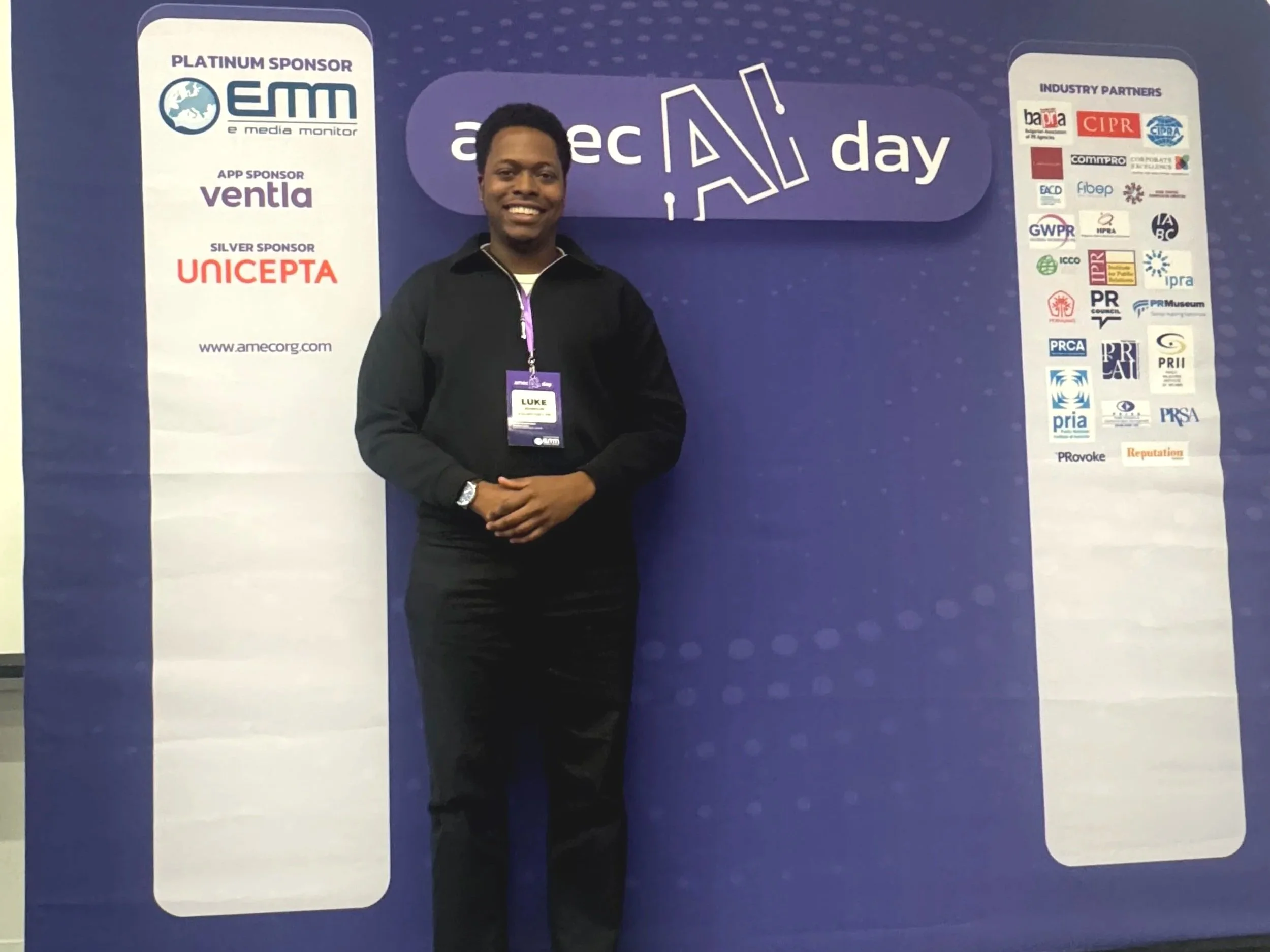
Luke Johnson at AMEC AI Day London, 4th November 2026
Opening
“Time flies” is something you hear over and over again as a young person. But this is something that is only really dawning on me now. If somebody had told 18-year-old me where I would be now, I doubt I'd have believed it. But fast forward to today, and here I am writing my very first blog. I'll admit, writing about myself doesn't come naturally, which is awkward to confess when your job is literally writing about people. I am now three months into my internship at YourStory PR, and I don't think there is a better time to reflect on my journey so far. The good, the bad, and the honest parts. Whether you are a student considering going into PR or a seasoned professional reminiscing, I hope this read gives you an honest picture of what it's really like to go into PR in 2026.
Expectations
Uncertainty, doubt, and fear are three of the things most final-year students feel as they approach graduation and begin a new chapter of life. This feeling cannot be fully encapsulated or described, but things just start to feel a lot more real. When I graduated in July, one of my biggest worries was whether I would be able to keep up. Before this year, part-time retail work was the closest thing I had to work experience. I had aspirations of what I wanted to achieve and very big dreams, but the journey to get there is one which was unknown. Like many people starting out, I had a fairly vague idea of what working in PR would involve. Writing pitches, emails, working on projects, and lots of reading. But that would be an understatement. After a short internship at another agency earlier this year, which provided a first glimpse of agency life, YourStory PR took me on as an intern.
Starting out
The first few weeks were particularly trying, and working mostly from home added that extra hurdle to overcome. With nobody sitting next to me to ask a quick question, I caught myself many times writing a Slack message, deleting it, and rewriting it, all for my question to be answered within 30 seconds. That's why the days we meet in person, every week or two, make such a difference. Questions that would take email threads and plenty of messages to answer, get sorted in a couple of minutes. Plus, it's fairly easier to familiarise yourself with the people you work ever so close to, face-to-face. Every week brings its own challenges, opportunities, and tasks, with some activities making sense much quicker than others. From the start, the daily media scans went well; I not only found my method, but also kept up to date on breaking news and global affairs. Researching has always been one of my strengths, so being able to utilise it has made many of my day-to-day tasks much easier.
Although not everything was a walk in the park. Getting to grips with many of the other tasks is something which is taking more time to process. Learning new platforms, writing press releases and pitches, the list goes on. At times it can feel like an extra priority on a day filled with plenty of other priorities. The agendas, the call notes, the status reports, and bylines are all new to me, and every single one of them can feel like a landslide on any given day. You wouldn't think that finding the correct angle for a pitch or word for an email would be so difficult until you spend 20 minutes staring at the same screen.
What I have learned
During my time at university, I learned many useful skills that I use and will continue to use in my day-to-day life, from critical thinking and time management to writing under pressure. They all help, but PR makes you utilise them in its own special (but stressful) way. The very same strengths you thought you had turn into weaknesses in an instant. After 3 years at university, I was fairly confident in my writing ability, able to build an argument over 3,000 words long, supported by references and data. Then I wrote my first draft press release, which returned with plenty of comments and corrections. The hook sat too far into the release, which quickly taught me that writing an academic paper for a writer and a pitch for a journalist are very different. But the one thing it did highlight was my resilience. The will to clock in every day and keep working on your shortcomings. Looking at my more senior colleagues breeze through emails and tasks that I spend extended periods on may be humbling at first, but it also lets me know that there is a great deal of potential for me to grow and improve.
Word to my old self
If I were to give advice to pre PR me, I'd say that nobody starts a job knowing exactly what they are doing. Ask questions, even when you feel that the answer is obvious. Your work will come back with plenty of comments, so take the feedback, fix it, and don't take it personally.
What’s next?
Despite having many humbling moments over the last 3 months, one main thing that this internship has shown me is that the best way to learn is to get stuck in, even when you are not completely sure what you're doing. I'm still finding my voice on calls, and I still quadruple-check emails before sharing. There are many things I am not certain about, but the last few months have helped me put things into perspective. I know I still have a lot to learn, and I am sure there are plenty of challenges ahead of me. That's fine. Every one so far has taught me something about myself, and each week I understand a bit more than the last. Faith always reminds me there is a bigger picture, even when the deadline makes it hard to see. And even though time really does fly, I intend to push myself to higher heights and soar to greatness.