
What the Life Sciences Sector Can Teach Any Industry About Leadership and Talent

In late March, professionals gathered in London for the Black Professionals in Life Sciences Annual Summit, an event focused on equity, leadership, and what it takes to build organisations where diverse talent enters through the front door and advances, and leads. The panels drew on experience from across pharma, biotech, medtech, consulting, and agency life, and the conversations apply well beyond life sciences to any sector, including technology, where the gap between intention and structural change remains wide.
The pipeline problem is not a pipeline problem
One of the most important ideas of the day was that if you want more diverse representation at senior levels, there are only three levers. Recruit more people, promote more of the people already there, and let fewer of them go. Most organisations focus almost exclusively on the first lever and wonder why the numbers do not shift.
It is not enough to act on instinct about where the problems are. Panellists argued that data needs to sit at the heart of this work as a diagnostic tool. Where are people stalling? At what level? In which functions? What are the patterns in who gets sponsored versus who gets managed out? Good data makes it much harder to avoid the right decisions.
The three things people need to progress in their careers
When it came to what individuals need in order to move forward in an organisation, the framework that stood out was a combination of the right role, the right feedback, and the right sponsor. The role has to be suited to the person's strengths and visible enough to create opportunity. The feedback should be honest and delivered within a relationship based on trust. Feedback given before trust exists often does more damage than good. The sponsor is someone with standing in the organisation who is actively willing to put their name behind yours.
Related to this was an observation about how value gets assessed inside organisations. Every company has a stated set of values and knowing which behaviours are actually rewarded, what competence looks like in your specific context, and how decisions about people get made informally, is a form of strategic intelligence. Without it, people work hard in directions that do not register.
Roles do not have to exist before you take them
The habit of waiting for the ‘right job’ that matches your skills, your ambitions, and the level you believe you have already earned can keep talented people in a holding pattern indefinitely. The alternative is to think less in terms of structure and more in terms of where value needs to exist, then make the case for occupying that space.
Similarly, the idea of building a constellation of mentors rather than relying on a single figure came up with some force. The suggestion was that a useful network of advisors spans different functions. This could include someone at the CEO level who understands the view from the top, a CFO who can translate financial logic, a CTO who speaks the language of technology, a COO who knows how organisations operate. Different people illuminate different blind spots. And where no role model exists in a particular space, the invitation is to become one.
On imposter syndrome and what it is telling you
Imposter syndrome should not be overlooked; instead, it should be harnessed to enhance attention to detail rather than becoming a paralysing emotion. This feeling is a natural response to being in high-stakes situations. If navigating certain environments requires more effort from some individuals than from others, that effort fosters a level of capability and readiness that others may lack. The focus should not be on how you arrived at a particular place, but rather on what you do once you are there.
Similarly, leadership is not a title. It is the thing that happens when people around you start looking to you to solve problems, regardless of what your job description says. This distinction matters particularly in technology and life sciences, where seniority and influence do not always align neatly.
Sustainable leadership and the harder question
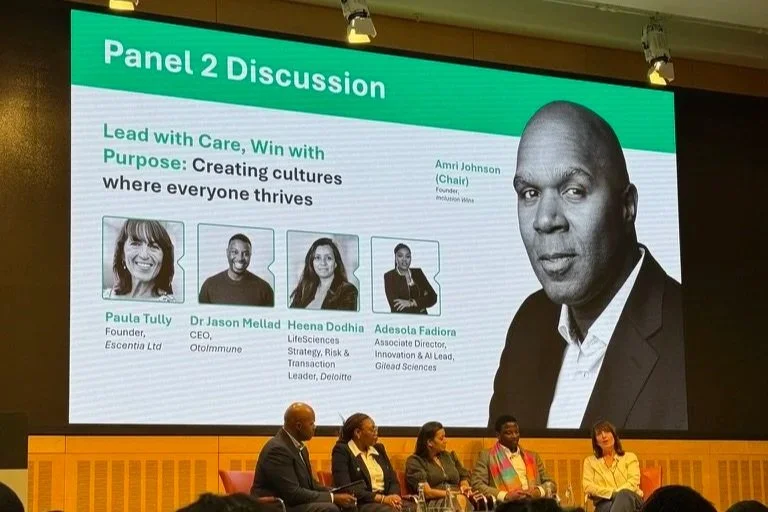
The second panel pushed into the territory of what it means to lead sustainably and in a way that does not deplete the person leading. One question that emerged was whether a person prefers to be rich or to be a king. While this may seem like a provocative choice, it invites a deeper reflection on what you are prioritising in your life. Your answer will influence nearly every decision you make regarding your career
There was also a reminder about the dynamics of building relationships at pace. The suggestion was to set aside one hour a week specifically for meeting people, either to offer something of value or to ask for it directly. When meeting with a senior leader, make the time worth theirs, and acknowledge that they gave it. This is the slow accumulation of trust and credibility that most things eventually run on.
Why this matters to us
At YourStory PR, we collaborate with companies in the technology and life sciences sectors. These are organisations that create impactful solutions and services, often under tight timelines. These companies face significant questions related to talent acquisition and retention, and the BPLS Summit emphasised that the most innovative approaches to these issues often arise in communities that are not always involved in strategic decision-making. Conversations like these are beginning to address these critical challenges.
Written by Oluwatomi Lawal