
How to Be Visible and Credible When Your Audience Is Both Human and Machine
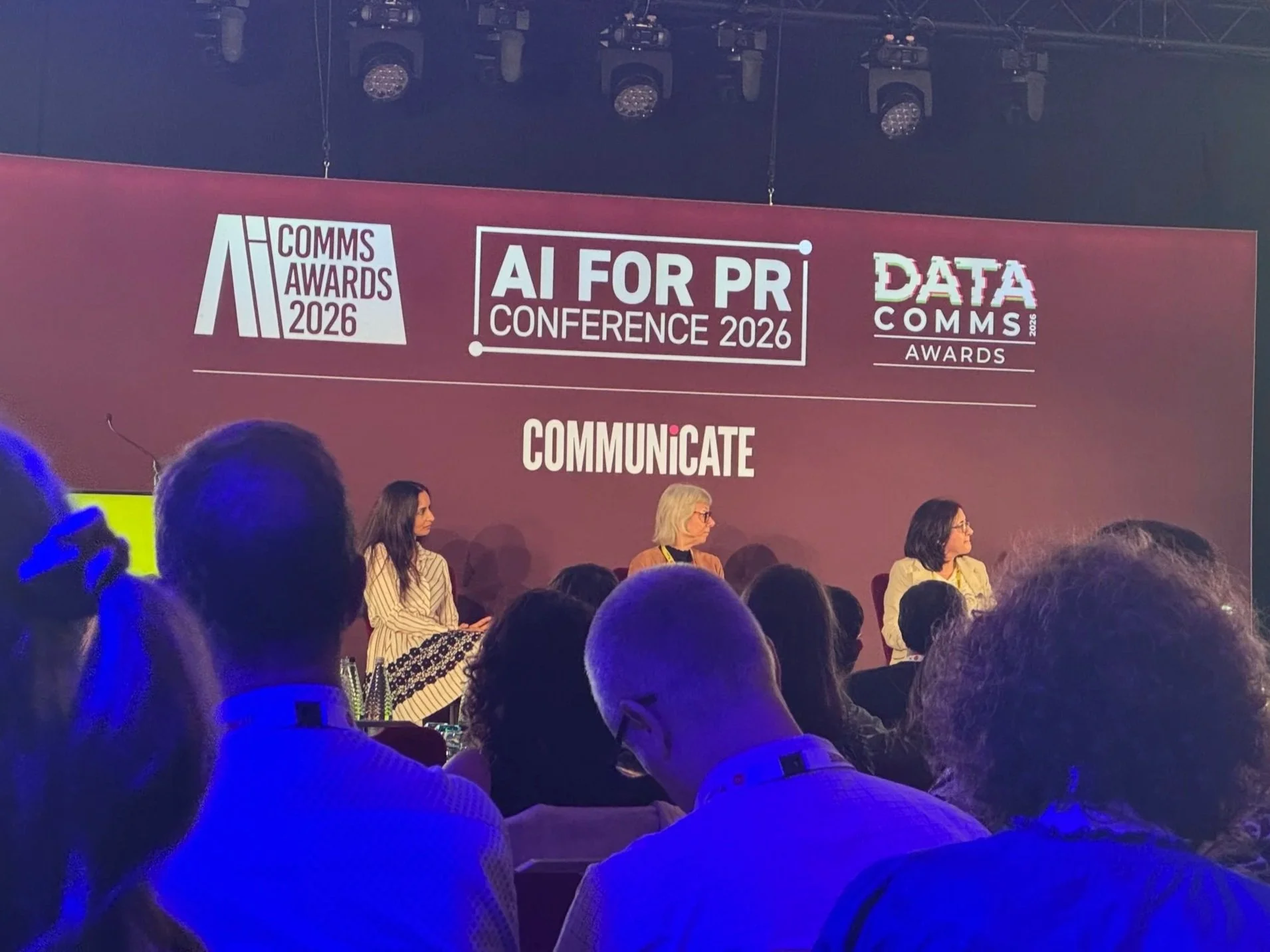
Ongoing panel session at AI for PR Conference 2026
Over the last few years, a new intermediary has gradually entered the conversation between brands and their audiences. Journalists have long filtered information between organisations and the public, while influencers shape perception through personality and trust. Today, Large Language Models increasingly perform both roles, deciding what information to surface and how to frame it.
Generative AI tools are now a primary channel through which people discover information, evaluate organisations, and make purchasing decisions, often before they ever encounter the sources these tools draw on. For communications professionals, the challenge is no longer just who we are talking to, but also what we are talking to and whether those systems understand and represent us accurately.
This was the thread running through every conversation at the 2026 AI for PR Conference in London, hosted by Communicate. Here are my key takeaways:
The People Reading Your Content Are Not All Human Anymore
Research shows that 80% of buyers use AI as their first port of call to help them make purchasing decisions, with half of those decisions made inside a generative AI tool before they leave it. 78% then went directly to a brand's own website or store and 90% or what shapes a generative AI tool's response comes from earned media.
When potential customers use AI tools to get recommendations about companies or products, the responses often rely on how others discuss the brand, rather than on the company's own marketing. As a result, communications strategies must assess not just how much coverage is being secured. The more important question is whether that coverage, alongside everything else in the public record about an organisation, is accurate, credible, and findable by AI when someone asks a relevant question.
Most brands have a content strategy focused on driving traffic to their owned channels. What many have not yet accounted for is whether that content, and the broader information about them across earned media and third-party sources, is consistent and structured in a way that AI can accurately interpret. Inconsistencies across channels and sources create confusion for large language models, which affects how and whether a brand surfaces in AI-generated answers. And because AI does not fact-check, inaccurate or contradictory information does not self-correct. It gets cited and shapes what potential customers, partners and investors see before any human intervention.
The Bar for What Earns Attention Has Moved
The presentation by Chris Stokel-Walker, a technology journalist, highlighted the growing gap between the amount of content produced and its value in communication. Journalists now receive hundreds of emails every day, leading to many unread messages piling up in their inboxes. To manage this, they are increasingly using AI tools to help filter and prioritise pitches or press releases. If a pitch is not relevant right away, it is likely to be ignored.
Similarly, audiences face an overload of content, much of it AI-generated, raising the bar for the tailored content that gets noticed. Good media relations has always relied on a good understanding of a journalist's recent work, their audience and the wider trends that impact them and that has never been truer than today. The best value we, as PR professionals, can offer a journalist is unique insights that address specific audience questions.
The discussion stresses that the goal should be to ensure that what we pitch and the content we create is relevant and well-informed. While producing content quickly is important given AI's impact on how information spreads, it is crucial to be deliberate in creating high-quality content that earns the attention it seeks.
Presence Without Credibility Is Not an Asset Anymore
Measuring communications has long focused on reach and volume. While these metrics are still relevant, they are no longer sufficient on their own. The industry is moving towards more detailed ways to measure success, like the AMEC GEO Principles introduced at this year's conference. This framework evaluates whether a brand appeared in the media, the nuances of what was said and the credibility of the source.
In today's AI-driven world, not all coverage is equally valuable. A mention in a well-respected publication is worth more than one in a source that lacks credibility. References from third-party experts have more weight than the brand's own statements.
This change shows that managing the flow of information is crucial. Earned media, expert opinions, third-party references, and trustworthy content are vital for successful communication. Visibility without credibility can be harmful, especially when inaccurate information spreads. The conversation about measurement needs to reflect these changes.
The Human Work Is Getting More Important, Not Less
As AI handles more of the process work in communications, the distinctly human capabilities become more valuable. Traits such as judgement, relationship-building, strategic thinking, the ability to understand context that no model has been trained on and the willingness to say something is wrong even when the output looks convincing.
Making effective use of AI requires a deliberate choice on how to integrate it into our work. Those who find real value in AI leverage the technology for research, repetitive administrative tasks, and creating initial drafts, allowing them to focus on strategy.

The YourStory PR Team at AI for PR Conference 2026
What to Do on a Monday Morning
An AI tool already has an answer about your organisation. The question is whether you have had any say in shaping it, and here are five steps to take:
Audit your AI presence - Open ChatGPT, Perplexity, Claude AI and Gemini and search your organisation as a potential customer or partner would. Note what comes back, where it draws that information from, and what is missing or inaccurate.
Review your content for machine readability - Identify your most important owned content and ask whether it is clear, structured and factual enough for AI systems to interpret and surface accurately. Overly promotional or vague material is less likely to be picked up and more likely to be ignored in favour of third-party sources.
Map your third-party credibility - List the external voices such as journalists, analysts, industry bodies, and partners currently speaking about your organisation. Are they saying what you would want an AI to repeat?
Have the measurement conversation with your team - If you are still reporting success in volume and impressions alone, introduce source credibility and accuracy into the discussion.
Pick one AI tool to integrate into your weekly workflow - Use it to research a journalist before a pitch, stress-test a key message, or sense-check how a story might land. Your goal should be fluency, and fluency comes from practice.
The PR and communications field is changing as AI becomes a key tool for connecting organisations with their audiences. If there was one takeaway from the conference, it was that communicators need to help shape its integration and not watch this shift from the sidelines.